


Bronchial asthma is a very common respiratory disease caused by inflammation of the small air channels of the lungs called bronchioles.
The inflammatory process leads to the formation of edema, increased production of mucus and spasms of the respiratory tree, obstructed the passage of air through the lungs. This process is called bronchospasm and is characterized by difficulty breathing, wheezing, coughing and a feeling of tightness in the chest.

In this article, we will explain asthma by addressing its causes, symptoms, diagnosis and homeopathic treatment options.
What Is Asthma
So that we can explain what asthma is and how it arises, we must first review some basic aspects of the anatomy of the respiratory system.
When we breathe in, air enters through the nose (or mouth), passes through the larynx and reaches the trachea, a calibrated tube that gives rise to the lower respiratory tract. The trachea bifurcates, forming the main bronchi, each one going towards one of its lungs. As they advance into the lungs, the bronchi go branching into smaller and smaller segments, called bronchioles, which in turn end up in the alveoli, the structure where oxygenation of the blood takes place. The terminal bronchioles are very small air channels, which have a diameter of only 0.5 mm.
For reasons still not well understood, patients with asthma develop a chronic inflammatory process in their small airways. This inflammation causes the asthmatic to be a person with a very sensitive lung. Simple environmental stimuli, such as exposure to pollen, smoke, dust, cold, etc., that are easily tolerated by the lungs of healthy people, usually cause a severe allergic reaction in the lungs of patients with asthma. This exacerbated reaction leads to the formation of edema in the bronchioles, production of excessive mucus and spasms of the bronchial muscle (bronchospasm), factors that cause a great reduction in the caliber of the respiratory tract, which makes the air passage difficult.
Asthamatic patient complains of discomfort in inspiring, and great difficulty to exhale, which leads to trapping of inhaled air inside alveoli, causing hyperinflation of lungs.
Fortunately, this obstruction caused by the reduction of the caliber of the respiratory tract is a reversible process, an essential feature that distinguishes asthma from chronic bronchitis and pulmonary emphysema, diseases known as COPD (chronic obstructive pulmonary disease).
Asthma is a disease that can disappear or present great improvement in adolescence. In some cases, it disappears and returns years later in adult life; in others, it goes away and never comes back. There are also patients who will develop asthma for the first time in adulthood, some only in the third age.

SYMPTOMS OF ASTHMA
Asthma is a disease that can occur at any age, but it is more common in children. In 75% of cases, it manifests before 7 years of age. It is estimated that the disease affects around 10% of the pediatric population and 5% of adults.
The most common signs and symptoms of asthma are dyspnea, coughing and bronchospasm (characterized by wheezing during breathing). Many patients also complain of a feeling of heaviness or compression in the chest. A typical feature of asthma is worsening of symptoms at night.
Asthma tends to manifest itself in attacks, which come and go and are triggered by some factors, such as respiratory viruses, smoke, cold, dust, animal hair, etc. When the patient is not in crisis, usually does not present symptoms, however, some degree of bronchospasm is usually present, mainly in patients with more severe forms of asthma. In general, these individuals adapt to this slight reduction in the caliber of the respiratory tract and do not report complaints on a day-to-day basis, unless they have to make an effort.
Classification of Asthma
1. Intermittent asthma
2. Mild persistent asthma
3. Moderate persistent asthma
4. Severe persistent asthma
- Intermittent asthma:- Asthma attacks occur less frequently than 2 days a week, the patient wakes up less than 2 nights a month with seizures, inhalers with bronchodilators are only needed in less than 2 days a week and asthma usually it does not influence routine activities.
- Mild persistent asthma:- Asthma attacks occur more frequently than 2 days a week (but not every day), the patient wakes up at least 3 to 4 nights a month with seizures, inhalers with bronchodilators are needed in more than 2 days a week (but not every day and no more than 1 time a day) and asthma can cause mild limitations in routine activities.
- Moderate persistent asthma:- Asthma attacks occur every day, the patient wakes up more than 1 time a week with seizures, inhalers with bronchodilators are needed every day and asthma can cause limitations in routine activities.
- Severe persistent asthma:- Asthma attacks occur daily, more than once a day, the patient wakes up every night with seizures, inhalers with bronchodilators are needed several times a day and asthma can cause serious limitations in routine activities.
Signs of severity of an asthma attack
Some patients, in addition to having persistent moderate to severe asthma, can also present severe acute asthma attacks, requiring immediate medical attention. Signs of severity of an asthma attack include:
- Great effort to breathe.
- Violet or bluish lips.
- Anxiety crisis.
- Difficulty speaking.
- Intense sweating.
- Clear use of the thoracic, abdominal or neck muscles during breathing
- Reduction of consciousness or mental confusion.
Causes And
Triggers Of Asthma
- We do not know exactly what causes an individual to develop asthma. However, we know that there is a strong genetic factor, because the disease tends to affect several members of the same family. If one of the parents has asthma, the risk of the child suffering from the disease is 25%. If the father and mother are asthmatic, the risk rises to about 50%.
- The relationship with allergic processes is also very evident, being very common the association of asthma with other allergies, such as atopic dermatitis, allergic rhinitis, urticaria, etc.
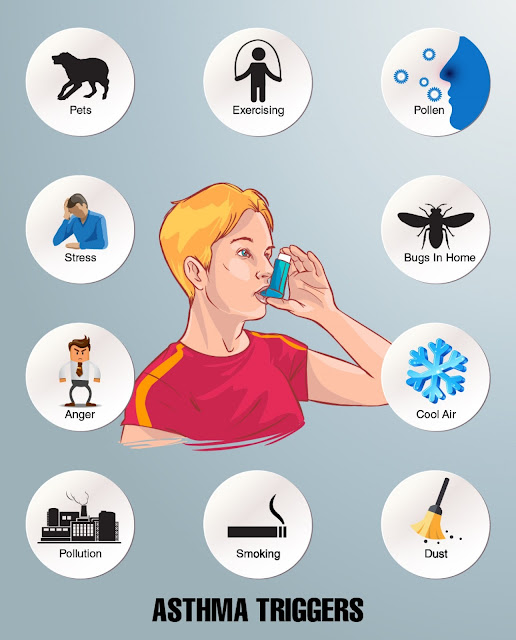
- Obese patients, smokers, passive smokers, people whose mothers smoked during pregnancy, babies with low birth weight, people exposed to fire smoke, patients with gastroesophageal reflux, workers exposed to certain chemicals or in contact with pesticides also increase the risk of developing bronchial asthma.
- Factors that trigger the asthma crisis: In general, in patients with asthma, asthma attacks are triggered by known factors that should be avoided whenever possible. In the vast majority of cases, the predisposing factors are substances inhaled by the air. Among the most common triggers of the asthma crisis are:

- Smoke.
- Cigarettes.
- Atmospheric pollution.
- Pollen.
- Dust.
- Hair of domestic animals.
- Mold
- Viral or bacterial infections of the respiratory tract.
- Strong smell of chemical products (paint, perfume, kerosene, etc.)
- Cold air.
- Mites.
- Environments with cockroaches.
- Allergy to certain foods (eggs, milk, peanuts, soy, seafood, dyes, etc.).
- Medications (aspirin, anti-inflammatories and beta-blockers).
- ASTHMA INDUCED BY EXERCISE:- Some people develop asthma attacks after practicing physical activities. The name asthma induced by exercise is not the most appropriate, because it can lead to the false understanding that the exercises can cause asthma. In fact, physical activity can trigger an asthma attack in a previously asthmatic patient. Therefore, the most correct term is bronchospasm induced by exercise.
- In most cases, the practice of physical exercises aggravates existing and symptomatic asthma. However, there are cases in which the patient’s asthma attacks after physical activity. The effort is the only trigger trigger of bronchospasm
- Bronchospasm crises usually appear 10 to 15 minutes after the onset of moderate to intense activity. In general, the symptoms disappear after 30 minutes of rest. Physical activities performed in cold environments increase the risk of asthma induced by exercises.
DIAGNOSIS OF ASTHMA
- The investigation of a patient with suspected asthma focuses, predominantly, on the evaluation of symptoms and tests that evaluate lung function. Other complementary tests, such as chest x-rays, blood tests and allergy tests, are useful in selected patients, but can not by itself establish or refute the diagnosis of asthma.
- In children, mainly in children, asthma can be difficult to diagnose because many other respiratory diseases can cause similar symptoms and the tests described below are usually not suitable for children. In children, therefore, the pediatrician can opt for a therapeutic test if there is suspicion of asthma. If the symptoms improve with treatment for asthma, it is most likely that the child has asthma.
- Spirometry: Spirometry is a study performed to evaluate how the lungs work. The test is very simple. For this, you must fill your lungs with air and then blow as quickly as possible into a mouthpiece connected to a computer. The spirometer evaluates two measures:
1- the volume of air that you can exhale in the first second of expiration, called forced expiratory volume in the first second or FEV1;
2- The total amount of air that you can exhale is called forced vital capacity or FVC.
To get a more reliable reading, the doctor may ask you to blow on the spirometer more than once. Once the doctor evaluates that the test was performed satisfactorily, he will compare the results with the reference values, which are average values obtained by people of the same age, sex and height. In this way it is possible to evaluate signs of airway obstruction.
- Maximum expiratory flow:- The peak expiratory flow meter, also called the peak flow meter, is a simpler alternative to evaluate the obstruction of the airways. The result obtained by the peak flow is called maximum expiratory flow (FEM). While in spirometry the patient must blow into a mouthpiece that is connected to a computer, the peak flow meter is a small handheld device, which can be kept at home and used to measure how quickly you can blow the air out of the air. the lungs in a single breath, short and explosive. As with spirometry, the results should be compared with the reference values. An improvement of at least 20% in the result after the use of bronchodilators speaks strongly in favour of asthma. This test, although simpler, requires a bit of practice to be done correctly and does not provide results as reliable as spirometry. Therefore, it ends up being more useful in the follow-up of patients who already have the diagnosis of asthma. As it can be done at home at any time, it is useful because it evaluates lung function throughout the day. Knowing the pattern of FEM helps the patient recognize when his asthma is getting worse. If the patient suspects there is an asthma trigger in his work, he can take the peak flow meter to work and compare the results before and after
Top Homeopathic Medicine For Asthma

- Ipecac
- Arsenicum
- Bromine
- Grindelia
- Viscum album
- Arsenicum
- Ipecac
- Nux vomica
- Zingiber
- Lycopodium
- Carbo vegetabilis
- Kali bichromicum
- Kali carbonicum
- Kali phosphoricum
- Natrum sulphuricum
- Antimonium tartaricum
- Blatta orientalis
- Moschus
- Ambra grisea
ASTHMA— LIFESTYLE AND DIET
- Avoid the allergen you are allergic to.
- Regular light Cardio exercise like yoga, brisk walk or jogging. Avoid heavy exercise as that can precipitate asthma attack.
- Do breathing exercises so as to improve lung capacity. eg Yoga -pranayam exercise.
- Do stress relieving meditation exercises or yoga to reduce the psychological factors related to asthma.
- Eat well balanced diet.


